
The Time and Cycle
Date : 12th September, 2026
Time : 10:30 A.M TO 11:45 P.M
Venue : Postmark Center For The Arts – Auburn Arts & Culture Center, 20 Auburn Ave, Auburn, WA 98002
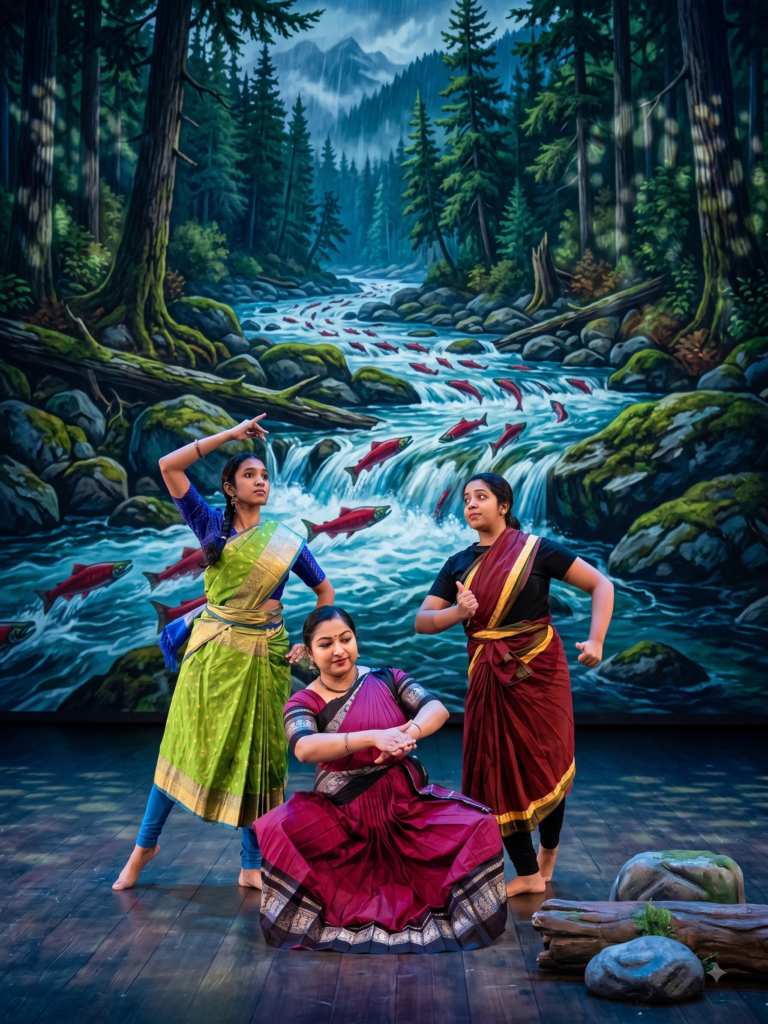
A Bharatanatyam Journey Through the Four Yugas
This performance journeys through the four yugas—Satya, Treta, Dvapara, and Kali—viewing time as a cycle rather than a straight line. Each yuga is explored through a story of Shiva and a parallel reflection from the landscapes, histories, and present-day life of Washington.
Opening Invocation
Pancha Jathi Alarippu — Time, Elements, and the Shatkona
The performance opens with Alarippu, a rhythmic invocation. Through earth, water, fire, air, and ether, the dancers evoke the elements and the changing seasons. The piece culminates in the shatkona—the interlocking triangles representing the union of Shiva and Shakti.Before story, There is rhythm.Before form, There is time.
Music: Pancha Jathi Alarippu
Tala: Five rhythmic
Jatis: Tisra, Chatusra, Khanda, Misra, and Sankeern, rhythmic cycle of 3,4,5,7 and 9
Composer : Padmabhushan awardee Guru Shobana
Track 1: The Churning of the Ocean and Shiva as Neelkanth
The story begins when Sage Durvasa offers Indra a sacred garland as a blessing. Indra places it on his elephant, Airavata, who throws it down and crushes it. Angered by this disregard for a divine gift, the sage curses Indra and the devas, causing them to lose their strength and radiance.
Weakened by the curse, the devas seek a way to restore balance. They join the asuras in churning the cosmic ocean, using Mount Mandara as the churning rod and the serpent Vasuki as the rope, in search of amrita, the nectar of immortality. But before the nectar can emerge, the deadly poison halahala rises from the ocean, threatening all creation. To save the worlds, Shiva drinks the poison and holds it in his throat, becoming Neelkanth, the blue-throated one.
This story reflects sacrifice: the strength to hold what is difficult so that life can continue.
Raga: Srothaswini
Tala: Adi
Composer: Madurai R. Muralidharan
Track 2: Washington Story — Salmon, Cedar, and River Memory
In the Pacific Northwest, life moves through cycles of return and endurance. Salmon journey from river to ocean and return to their native waters. Cedar withstands rain, wind, and winter. Rivers remember their paths through changing landscapes.
This interlude reflects the same idea of continuity: life survives through return, resilience, and relationship with the natural world.
Track 1: Evarunnaru Brova
Rama Seeks Shiva’s Grace
Before the battle in Lanka, Rama stands at the seashore, carrying the weight of responsibility, longing for Sita, and concern for those who depend on him. In humility, he turns to Shiva for courage, clarity, and steadiness of mind.
Through the question, “Who else is there to protect me?”, the piece expresses the human need for grace during moments of uncertainty and duty.
Raga: Malavasri
Tala: Adi
Composer: Saint Tyagaraja
Track 2: Washington Story — Every Crossing Leaves a Trace
This interlude reflects on movement across water and land: canoes, ships, trails, roads, and railways. Such crossings have carried people, stories, trade, hope, and new possibilities. They have also brought conflict, displacement, and changes that remain in the memory of the land and its people..
Every crossing leaves a trace. Our actions shape the paths that others inherit.
Track 1: Kirata Arjuna
Arjuna performs deep penance to seek strength before a great battle. Shiva appears before him in the form of a hunter, and the two enter a fierce contest. Arjuna struggles, exhausts his strength, and finally recognizes that the hunter is Shiva himself.
Pleased by Arjuna’s courage, discipline, and humility, Shiva reveals his divine form and grants him the Pashupata weapon. The story reminds us that true strength is shaped through testing, surrender, and self-awareness.
Track 2: Washington Story — After Ash, Green
Mount St. Helens erupts. Ash rises, the landscape falls silent, and what once seemed familiar is transformed. Yet in time, life returns: small growth appears, green emerges, and the land begins again.
Like Arjuna’s test, this story speaks of challenge and renewal. What is broken is not always the end of the story.
Track 1: Ananda Natam Idum Padan
Shiva’s Joyful Dance
Kali Yuga is an age of rapid change, distraction, confusion, and inner unrest. A seeker attempts to find stillness, but thoughts, worries, noise, and uncertainty pull the mind in many directions.
The turning point comes through surrender. One sincere prayer, one steady rhythm, and one inward moment become a path back to peace. Shiva’s dance reminds us that grace is not far away—it is present within.
Raga: Kedaragowla
Tala: Adi
Composer: Papanasam Sivan
Track 2: Washington Story — Life in a Fast-Moving City
This interlude reflects on modern urban life: people rushing in different directions, screens competing for attention, and the challenge of staying connected—to one another, to truth, and to nature.
Amid movement and noise, the performance asks: How do we return to stillness? How do we make space for attention, compassion, and balance?
Tham Tham Thakajonu Tham
Raga: Gambeera Naatai
Tala: Adi Talam
Composer: Kunnakudi Vaidyanathan
Concept & Choreography – Manaswini Sridhar
Dancers : Manaswini Sridhar, Noopura Radhakrishnan, Mehal Kashyap
Story Teller – Smt. Kavya Sivaramakrishnan
Violin – Smt. Nandini Viswanathan
Mridangam – Myan Sudarshan